Spaces That Only Exists When Opened
- May 1
- 2 min read
I want to talk about an artist’s book.
This was my first attempt at hand-binding—an edition of 25. The idea came from a desire to rethink how paintings are viewed. Instead of reproducing images in the conventional way, where beauty is preserved through documentation, I was more interested in how the act of reading a book might reshape the experience of spatial painting.


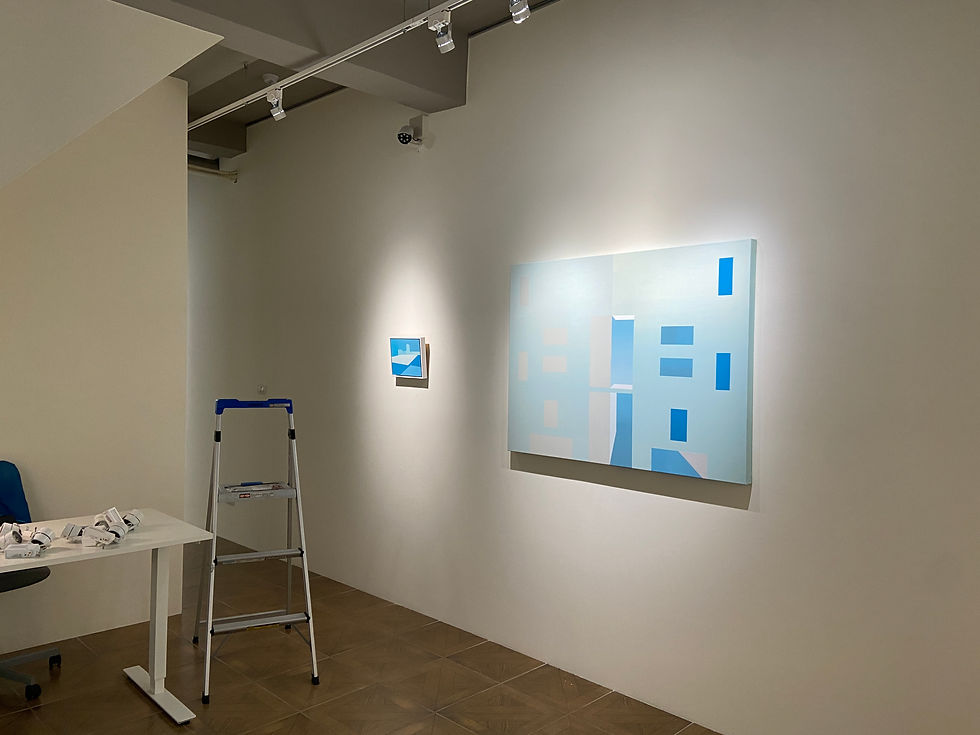
I selected works from my geometric and urban series, reduced them into single-color forms through risograph printing—I’ve always been drawn to blue—and began linking them together. Individual images quickly lost their autonomy, dissolving into a collective field of forms where meaning emerged through sequence and adjacency.


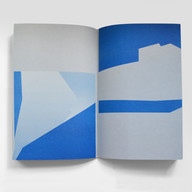


But that wasn’t enough. I pushed the idea of “continuous space” further by folding each page into an accordion structure. It became a nodal continuum—when unfolded, a fluid visual passage; when closed, a compact object, a fragment that exists on its own.

Two years after completing the book, Apple TV released a series called Severance. I only watched it recently. The endless, directionless corridors—spaces that connect yet never resolve—created a visceral discomfort. The show speaks to how systems redefine and partition individuals, stripping away any sense of continuity. It pulled me back into the headspace of making this book.
A few of them were already grabbed by visitors at the art book fair I attended years ago; only a few remain with me now, in no particular order. I let people choose them randomly and I like how the remaining copies exist in a severed sequence—the missing numbers are out there in other people's spaces, leaving these fragments behind.
Only when it is opened does the space come into being.


Sticker I love from Tokyo Art Book Fair&some copies left.