48 Cards of Time
- Apr 12
- 2 min read
Around mid-July last year, I began developing an art project—one that tells a story entirely my own. In a way, it feels like the starting point for many artists. I set out to trace and piece together my family’s history.
As a third-generation waishengren, I’ve often felt a certain resonance with the Chinese diaspora, while also feeling a deep uncertainty about my own cultural identity. It started with a box of old photographs, tucked away in a corner of my home. As I went through them, fragments of unanswered questions slowly began to fall into place. With the help of AI, I was able to reconstruct parts of my grandparents’ backgrounds and sketch out a rough timeline of their migration. Stories that had never been told—or had been deliberately buried—began to surface in new forms, as if missing pieces of a foundation were gradually being put back together.


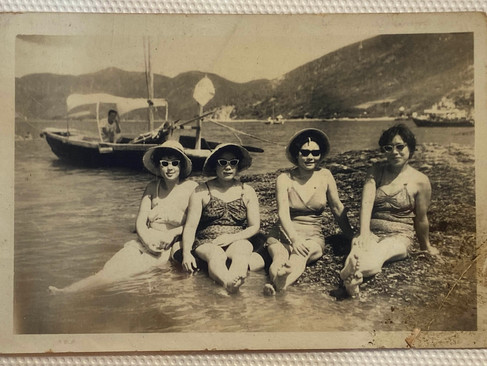
Grandpa with the Republic of Korea Air Force / Grandma with friends at a beach in Gyeongsangnam-do
At some point, I realized that my life seems to orbit around two women: my grandmother and my mother. If I could understand their pasts, I might be able to piece this story together in a more complete way. But both of my grandparents have passed away. The only people left who can offer any oral history—my parents—either don’t know much, or remember things through a lens shaped by their own emotions. So I’ve come to accept that this project will largely be something I construct myself. The question then is: how do I tell this story?
Then, almost out of nowhere, an image came back to me. I remembered the Hwatu cards my grandmother used to play by herself when I was a child. I did some research and found that this card system originated in Japan during the Edo period, emerging under gambling restrictions and the influence of imported playing cards, while also continuing earlier systems such as kai-awase, where images and objects were paired to carry layered meanings of time and symbolism. The imagery follows the cycle of the four seasons—four cards for each month, making a total of 48—with a kind of coded sense of time embedded within it. The version my grandmother played, however, was Korean, with slight variations in imagery, though the rules are largely the same.

My grandmother never explained the game to me. In fact, she seemed uneasy having me around when she played. Later, I learned that in Korea these cards are closely tied to gambling, and carry a certain sense of taboo. I also came across the idea that, in some contexts, they can be read in ways that resemble fortune-telling. In any case, I chose hwatu as the framework for this project: 48 cards as its underlying structure.
I plan to center the work around three women—my grandmother, my mother, and myself—tracing a timeline from the 1930s to the present. I’ve been working on this project for about six months now. Most of the archival material has been organized, and I’ve already started making a number of pieces.


Sketches of the Hanafuda project.


